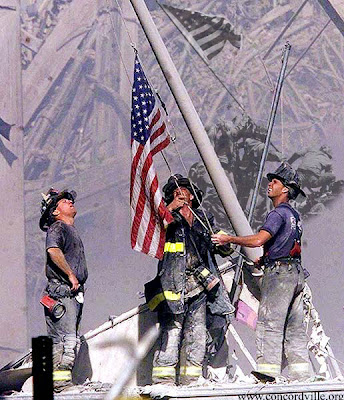
The attacks of September 11, 2001, forever changed the way that Americans think about their national security. It made clear that the need to confront transnational terrorism is a reality of the new age of globalization that is drawing the world closer together. In the wake of those attacks, there was an international outpouring of sympathy for the United States, symbolized by the French newspaper Le Monde's headline, "We Are All Americans." Even in Iran, "vast crowds turned out on the streets and held candlelit vigils, [and] sixty-thousand spectators respected a minute's silence at Tehran's football stadium." But rather than take advantage of the unprecedented international solidarity to bring about better international cooperation against terrorism, President Bush retreated into the familiar "us vs. them" dichotomy that has characterized conservative foreign policy since the mid-20th century. Making his cause clear in a speech to Congress on Sept. 20, Bush declared a "war on terror," promising "a lengthy campaign, unlike any other we have ever seen." America's new global posture was summarized in one sentence: "Either you are with us, or you are with the terrorists."
Seven years later, President Bush has squandered the goodwill of the world. Global opinion of the United States is lower than at almost any time in history. Our country remains deeply involved in wars in Afghanistan and Iraq, which continue to drive extremist anti-American ideologies. Tragically, even though it has used the rhetoric of freedom and democracy to defend its policies, the Bush administration remains wedded to a national security strategy that prioritizes the use of military force and denies the full range of American economic, political, and cultural power. Recently, senior U.S. intelligence analyst Thomas Fingar presented the findings of a new report, "Global Trends 2025," that "assesses how international events could affect the United States in the next 15 to 17 years." Fingar said that "the U.S. will remain the preeminent power," but he saw U.S. leadership eroding "at an accelerating pace" in "political, economic and arguably, cultural arenas." The Washington Post reported that, according to Fingar, "the one key area of continued U.S. superiority -- military power -- will 'be the least significant' asset in the increasingly competitive world of the future."
Despite the changing world dynamic, military power continues to be the asset which the Bush administration has most often used in the misnamed and misconceived Global War on Terror. After routing al Qaeda and its Taliban hosts from their base in Afghanistan in late 2001 and 2002, Bush turned his attention to Iraq, where the U.S. military continues its occupation to this day at a cost of over $12 billion a month. More than one in five Iraqis has been displaced since the 2003 invasion, both inside and outside the country. The 2007 troop surge, while helping to reduce violence, has also frozen in place "a fragmented and increasingly fractured country," with no sign that Iraq's leaders are prepared to make the tough power-sharing compromises necessary for a stable future Iraq. As a result of the unfinished war in Afghanistan, the Taliban, and al Qaeda eventually regrouped in the Afghanistan-Pakistan border areas, and have carried out an increasingly destructive insurgency. According to the Foreign Policy/Center for American Progress 2008 Terrorism Index, which surveyed 117 national security experts from across the political spectrum, "eighty percent of the experts say that the United States has focused too much on the war in Iraq and not enough on the war in Afghanistan." Yesterday, Chairman of the Joint Chiefs of Staff Adm. Michael Mullen warned Congress that the United States. is "running out of time" to succeed in Afghanistan and that sending in more troops will not necessarily guarantee victory.
Mullen's other comments offer a clue to the way forward. In discussing the Afghanistan front, Mullen noted the "poor and struggling Afghan economy" and "significant political uncertainty in Pakistan" as major barriers to real security and progress in the region. As Center for American Progress Senior fellow Brian Katulis and co-author Nancy Soderbergh argue in their new book, "The Prosperity Agenda," American leadership "has been absent from the scene of many other important global issues -- oil dependency, food shortages, climate change, global poverty, and stopping the spread of nuclear weapons." Americans must expand their conception of national security to encompass more than military solutions for what are in many cases environmental, economic and political problems. With the continuing rise of economic competitors such as China and Russia, the United States must acclimate its security policies to an evolving multi-polar reality in order to work more effectively to deal with problems like Iran's nuclear program. And with the persistence of non-state actors such as Al Qaeda, the United States must look to a more comprehensive approach to national security, one that addresses the conditions which give rise to terrorism, and rethink its reflexive dependence on military power as the first option against potential threats.


